
Train Brilliantly
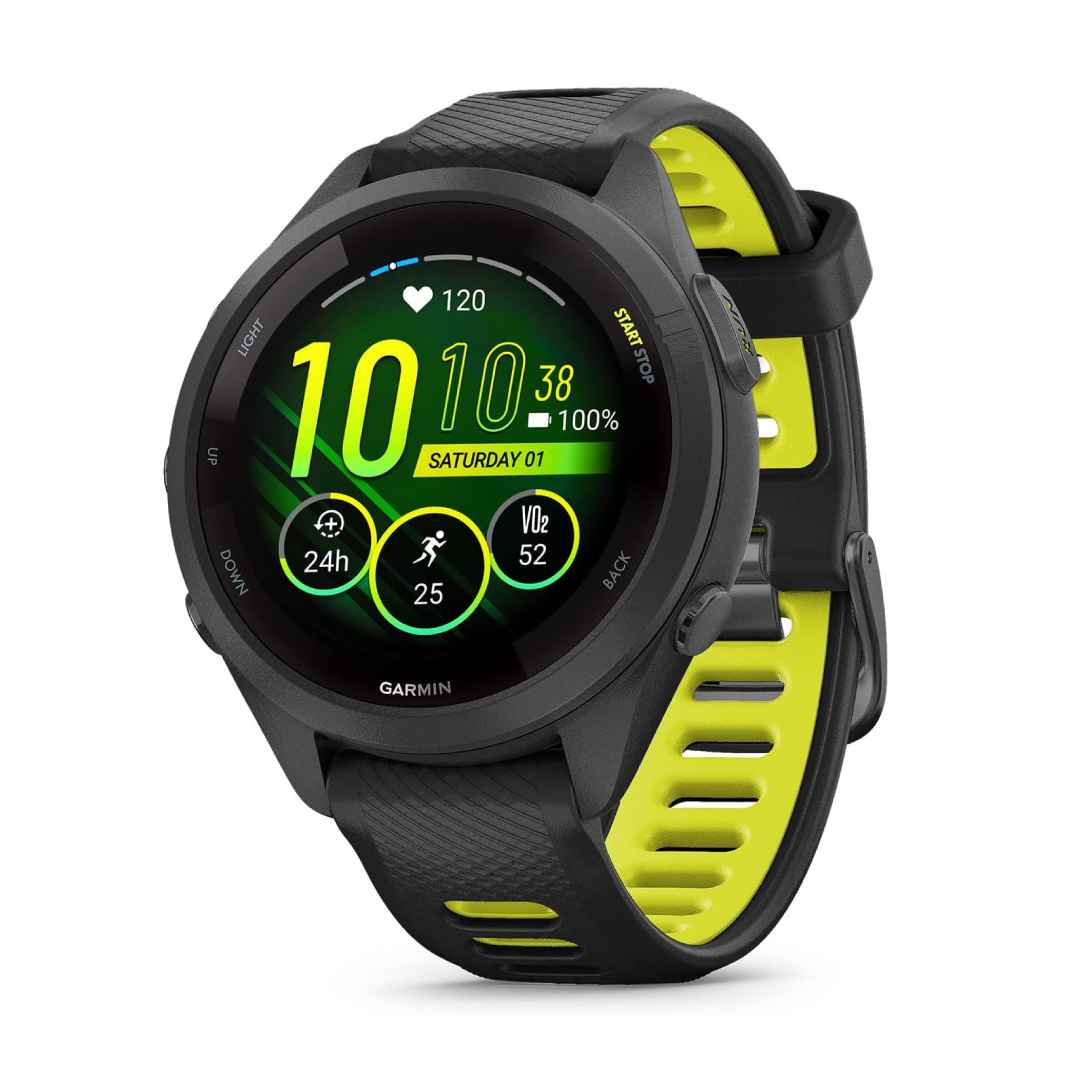
The Garmin Forerunner 265S is a compact, high-performance GPS running smartwatch tailored for ambitious athletes with smaller wrists, featuring a vibrant 1.1-inch AMOLED touchscreen display (416 x 416 pixels) with always-on capability and Corning Gorilla Glass 3 protection for sharp, sunlight-readable visuals during intense sessions. Powered by advanced multi-band GNSS with SatIQ technology for pinpoint accurate tracking in urban canyons or dense forests, it delivers comprehensive insights like Training Readiness Score, HRV status, VO2 max, lactate threshold, and adaptive daily suggested workouts that evolve with your performance and recovery needs. Wrist-based heart rate monitoring, Pulse Ox for blood oxygen, and over 30 activity profiles—including running, triathlons, cycling, swimming, and yoga—ensure versatile multisport support, while built-in music storage for up to 500 songs from Spotify, Deezer, or Amazon Music lets you go phone-free with Bluetooth headphones. Weighing just 39 grams in its lightweight fiber-reinforced polymer case (available in Slate Gray, Tidal Blue, or Whitestone), it offers exceptional battery life of up to 15 days in smartwatch mode or 24 hours in GPS mode, plus smart notifications, Garmin Pay contactless payments, and safety features like incident detection. Running on Garmin’s intuitive interface with five physical buttons alongside touch controls, this powerhouse integrates seamlessly with the Garmin Connect app for holistic health tracking, making it the ideal companion for runners chasing personal bests without the bulk of larger watches.
Key Features
Compact AMOLED Display with Always-On Visibility
The Forerunner 265S features a bright 1.1-inch AMOLED touchscreen with 416 × 416 resolution and always-on functionality, protected by Gorilla Glass 3. Even in direct sunlight, race pace, heart rate zones, and maps remain crisp and readable without raising your wrist, while the smaller 41 mm case fits comfortably on narrower wrists.
Advanced Training Readiness and Recovery Insights
Garmin’s Training Readiness score combines sleep quality, recovery time, HRV status, acute training load, and stress history to tell you whether today is a hard workout day, an easy recovery run, or a rest day. Morning Report and adaptive daily suggested workouts adjust automatically as your fitness improves or when fatigue sets in.
Multi-Band GPS with SatIQ Precision
SatIQ technology dynamically switches between single-band and multi-band GNSS depending on your environment, delivering ultra-accurate tracking in challenging urban or trail settings while preserving battery life. Whether you’re weaving through city skyscrapers or running under heavy tree cover, distance and pace stay reliable to within a few meters per kilometer.
Built-in Music Storage and Phone-Free Runs
Store up to 500 songs directly on the watch from Spotify, Deezer, or Amazon Music (premium subscription required). Pair any Bluetooth headphones and leave your phone at home—control playback, volume, and skip tracks right from your wrist without interrupting your stride.
Exceptional Battery Life for a Full-Color Smartwatch
Despite the power-hungry AMOLED screen, the 265S lasts up to 15 days in smartwatch mode, 24 hours in GPS-only mode, or 7 days with always-on display and regular workouts. A single charge easily covers an entire training week plus a marathon-length race with music streaming.
What’s in the Box
- Garmin Forerunner 265S
- Charging Cable
- Documentation
FAQs
Is the 265S too small for larger wrists, and how does it compare to the standard 265?
The 265S has a 41 mm case diameter and 39 g weight, making it ideal for smaller wrists (under 150 mm circumference) where it sits flush without gaps. On larger wrists, it can look and feel undersized compared to the 46 mm Forerunner 265, but the display remains fully functional—many users with 170+ mm wrists still prefer it for its lighter profile during long runs.
How accurate is the wrist-based heart rate during intense workouts or cold weather?
In ideal conditions (room temperature, steady pace), it’s highly accurate within 2–3 bpm of a chest strap like the HRM-Pro, thanks to the Elevate V4 sensor. However, during high-intensity intervals, HIIT, or cold weather below 5°C (41°F), it can lag or overestimate by 5–10 bpm due to motion artifacts or vasoconstriction—pairing with an external HR monitor is recommended for precision training.
Does the battery life hold up to 15 days in real-world use with music and GPS?
With always-on display off, daily notifications, and occasional workouts, most users achieve 10–12 days in smartwatch mode. Enabling music playback (e.g., 2 hours daily) and multi-band GPS drops it to 6–8 days, while full GPS + music for a marathon uses about 16–20 hours—still class-leading, but heavy multisport users may charge every 4–5 days.
What makes the Training Readiness score useful, and how accurate is it for beginners?
The score (0–100) factors in sleep, HRV, recovery time, stress, and recent training load to recommend if you’re ready for hard efforts or need rest. It’s highly insightful for intermediate runners optimizing race prep, with 85–90% correlation to perceived fatigue in studies, but beginners may find it overwhelming initially—start by focusing on the simplified Morning Report for actionable daily insights.


Reviews
There are no reviews yet.